
MASTERED FROM THE ORIGINAL MASTER TAPES, LIMITED TO 10,000 NUMBERED
COPIES, AND HOUSED IN AN ELEGANT SLIPCASE
1/4" / 15 IPS
analog master to DSD 256 to analog console to lathe
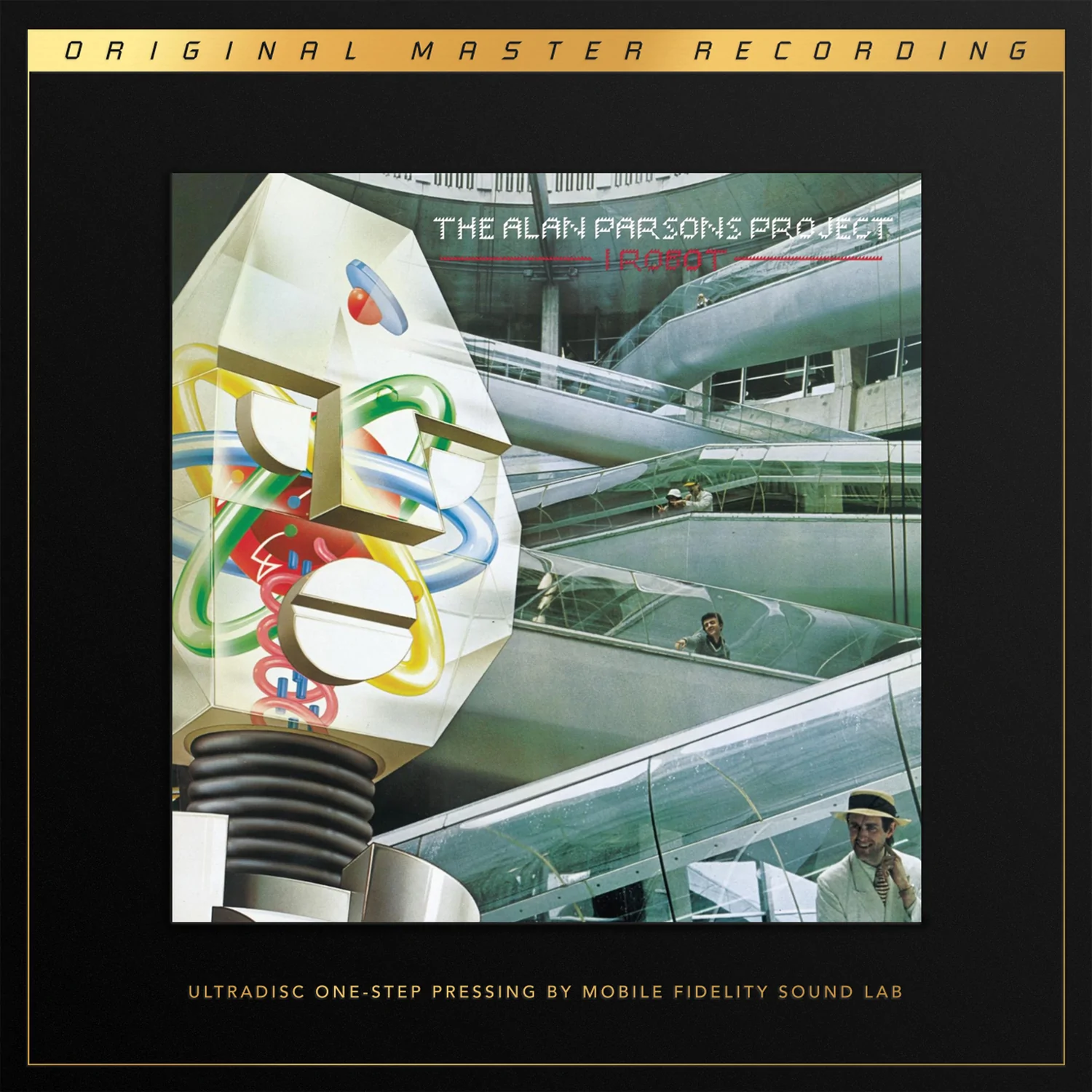
Most audiophiles
know Alan Parsons Project's I Robot by heart. Engineered by Parsons
after he performed the same duties on Pink Floyd's Dark Side of the
Moon, the 1977 record reigns as a disc whose taut bass, crisp highs,
clean production, and seemingly limitless dynamic range are matched
only by the sensational prog-rock fare helmed by the keyboardist and
his creative partner, Eric Woolfson. Not surprisingly, it's been
issued myriad times. Can it be improved? Relish Mobile Fidelity's
stupendous UltraDisc One-Step 180g 33RPM box set and the question
becomes moot.
I Robot
I Wouldn't Want to
Be Like You
Some Other Time
Breakdown
Don't Let It Show
The Voice
Nucleus
Day After Day (The
Show Must Go On)
Total Eclipse
Genesis Ch. 1 V. 32
Mastered from the
original master tapes and pressed at RTI on MoFi SuperVinyl, I Robot
comes to life with reference-setting realism on this numbered,
limited-edition reissue. Boasting immaculate highs and lows, generous
spaciousness, and see-through transparency that takes you into the
studio with Parsons and Woolfson at Abbey Road, this definitive
edition is designed to demonstrate the full-range capabilities of the
world's best stereo systems while offering listeners the convenience
of having all the music on one LP.
Featuring a nearly
inaudible noise floor, this transcendent UD1S edition functions as a
repeat invitation to savor reference-grade soundstages, immersive
smoothness, sought-after instrumental separation, three-dimensional
imaging, and consummate tonal balances. Able to be played back at
high volumes without compromise or fatigue, it is a demonstration
record for the ages – the likes of which are no longer being made.
This is the very reason you own and invest in high-end audio gear.
The special
characteristics of this UD1S version extend to the premium packaging.
Housed in an elegant slipcase, the reissue features special
foil-stamped jackets and faithful-to-the-original graphics. Aurally
and visually, it is made for discerning listeners who prize sound
quality and production, and who desire to fully immerse themselves in
everything about this conceptual landmark. The Alan Parsons Project's
most famous record deserves nothing less.
Inspired by and
loosely based around the Isaac Asimov stories of the same name, I
Robot delves into themes of artificial intelligence and technological
dominance that make the record extremely relevant in the 21st
century. Indeed, Parsons and Woolfson's pinnacle creation dovetailed
with the ascendency of Star Wars, which itself is experiencing a
rebirth in an age of self-driving cars, smart devices, and mindless
automation. Lyrically, songs such as "The Voice" call into
question human behavior – and their relationship to increasing
robotic supremacy – in everyday life. Parsons and Woolfson reflect
the associated paranoia, dichotomy, and transformation via shifting
sci-fi arrangements steeped in drama and moodiness.
The absorbing tunes
on I Robot also continue to fascinate due to their perfectionism and
innovation. Borrowing from Pink Floyd's strategies, Parsons and
Woolfson utilize a looped sequence on the title track to create new
downbeats. "Some Other Time" employs two different lead
vocalists and yet gives the illusion that only one is involved.
Captivating strings, a piccolo trumpet, and bona fide pipe organ
grace "Don't Let It Show." The origins of "Nucleus"
stem from a unique analog keyboard concoction dubbed "the
Projectron," devised by Parsons and electronic engineer Keith
Johnson. Andrew Powell's orchestral and choral arrangements top it
all off, with "Total Eclipse" arriving as a frightening
track that presages the climactic "Genesis Ch. 1 V. 32."
Does man or machine
win in the end? Decide as you get lost in Mobile Fidelity's UltraDisc
180g 33RPM LP pressing. Secure your numbered copy today!
More About Mobile
Fidelity UltraDisc One-Step and Why It Is Superior
Mobile Fidelity
Sound Lab's UltraDisc One-Step (UD1S) technique bypasses generational
losses inherent to the traditional three-step plating process by
removing two steps: the production of father and mother plates, which
are created to yield numerous stampers from each lacquer that is cut.
For UD1S plating, stampers (also called "converts") are
made directly from the lacquers. Since each lacquer yields only one
stamper, multiple lacquers need to be cut. Mobile Fidelity's UD1S
process produces a final LP with the lowest-possible noise floor. The
removal of two steps of the plating process also reveals musical
details and dynamics that would otherwise be lost due to the standard
multi-step process. With UD1S, every aspect of vinyl production is
optimized to produce the best-sounding vinyl album available today.
MoFi SuperVinyl
Developed by NEOTECH
and RTI, MoFi SuperVinyl is the most exacting-to-specification vinyl
compound ever devised. Analog lovers have never seen (or heard)
anything like it. Extraordinarily expensive and extremely painstaking
to produce, the special proprietary compound addresses two specific
areas of improvement: noise floor reduction and enhanced groove
definition. The vinyl composition features a new carbonless dye (hold
the disc up to the light and see) and produces the world's quietest
surfaces. This high-definition formula also allows for the creation
of cleaner grooves that are indistinguishable from the original
lacquer. MoFi SuperVinyl provides the closest approximation of what
the label's engineers hear in the mastering lab.
THE CONSUMMATE VERSION OF TAPESTRY: DELUXE AUDIOPHILE PRESSING LIMITED TO 10,000 NUMBERED COPIES180g 45RPM 2LP Box SetCarole King's Tapestry is the rare record that plays in your head the moment its title, cover art, or songs are mentioned. Ranked the 25th Greatest Album of All Time by Rolling Stone, it is the singer-songwriter LP you'd bring to the proverbial desert island if you were limited to one choice. Renowned for its lifelike production, Tapestry sounds clearer, richer, and more emotional than ever courtesy of Mobile Fidelity's UltraDisc One-Step reissue.
I Feel the Earth Move
So Far Away
It's Too Late
Home Again
Beautiful
Way over Yonder
You've Got a Friend
Where You Lead
Will You Love Me Tomorrow
Smackwater Jack
Tapestry
(You Make Me Feel Like) A Natural Woman
Commemorating the record's 50th anniversary in collaboration with SME/Legacy Recordings, mastered from the original master tapes, cut at 45RPM, pressed on MoFi SuperVinyl at RTI, and limited to 10,000 copies, the iconic audiophile label's UD1S 180g 45RPM 2LP box set remains faithful to original album producer Lou Adler's vision of making King (and not just any pianist player) appear seated and playing just for you. Friends, this is the edition that brings King right before your eyes and into your room.
Visually, the lavish packaging and gorgeous presentation of the UD1S Tapestry befit its select status. Housed in a deluxe box, it features special foil-stamped jackets and faithful-to-the-original graphics that illuminate the splendor of the recording. No expense has been spared. The UD1S set exists as a curatorial artifact meant to be preserved, touched, and examined. It is made for discerning listeners that prize sound quality and production, and who desire to fully immerse themselves in the art – and everything involved with the album, from the images to the finishes.
Aware of how many times this iconic work has been re-released, Mobile Fidelity engineers ensured this UD1S edition benefits from lifelike spaciousness, presence, fullness, dynamics, and openness. The wider grooves allow more information to reach your ears, and MoFi SuperVinyl means the noise floor is as absolutely low as possible. The results mirror what went down in A&M Studios: Lean, simple, direct, and so nakedly real the sonics evoke what might be heard on a professional demo tape.
King's personal singing, her graceful pianism, and the integral rhythmic foundation provided by the likes of drummer Russ Kunkel and guitarist Danny Kortchmar – and the contributions of guest instrumentalists ranging from saxophonist Curtis Amy to guitarist James Taylor – resonate with three-dimensional imaging and cozy realism. Every note, and every basic movement, is accurately rendered with exquisite detail and full-bodied tonality.
Indeed, one reason Tapestry endures – apart from the flawless songwriting, earnest deliveries, and eloquent performances – owes to the naturalness of the production and songs. King's articulations on love, conviction, friendship, place, sadness, and companionship ring true because there's no doubting their meaning, intent, or sincerity. Tapestry makes you feel. It compels you to get closer to the music and the musicians performing. It is an album of organic nuances, suggestive intents, and engaging melodies.
Classics such as "You've Got a Friend," "I Feel the Earth Move," "Will You Still Love Me Tomorrow," and "(You Make Me Feel Like) A Natural Woman" resonate because they address universal sensibilities and the human condition. They, like all of Tapestry, are relaxed yet emancipating, strong yet mellow, comfortable yet terrifically beautiful and lastingly unique. Four major Grammy Awards, four Top 10 singles, and worldwide sales of more than 25 million copies just seem like icing on the cake.
There's only one Tapestry, and Mobile Fidelity's collectible UD1S version weaves together all its elements in incomparable fashion. Secure your lowest-numbered copy today!
More About Mobile Fidelity UltraDisc One-Step and Why It Is Superior
Instead of utilizing the industry-standard three-step lacquer process, Mobile Fidelity Sound Lab's new UltraDisc One-Step (UD1S) uses only one step, bypassing two processes of generational loss. While three-step processing is designed for optimum yield and efficiency, UD1S is created for the ultimate in sound quality. Just as Mobile Fidelity pioneered the UHQR (Ultra High-Quality Record) with JVC in the 1980s, UD1S again represents another state-of-the-art advance in the record-manufacturing process. MFSL engineers begin with the original master tapes and meticulously cut a set of lacquers. These lacquers are used to create a very fragile, pristine UD1S stamper called a "convert." Delicate "converts" are then formed into the actual record stampers, producing a final product that literally and figuratively brings you closer to the music. By skipping the additional steps of pulling another positive and an additional negative, as done in the three-step process used in standard pressings, UD1S produces a final LP with the lowest noise floor possible today. The removal of the additional two steps of generational loss in the plating process reveals tremendous amounts of extra musical detail and dynamics, which are otherwise lost due to the standard copying process. The exclusive nature of these very limited pressings guarantees that every UD1S pressing serves as an immaculate replica of the lacquer sourced directly from the original master tape. Every conceivable aspect of vinyl production is optimized to produce the most perfect record album available today.
MoFi SuperVinyl
Developed by NEOTECH and RTI, MoFi SuperVinyl is the most exacting-to-specification vinyl compound ever devised. Analog lovers have never seen (or heard) anything like it. Extraordinarily expensive and extremely painstaking to produce, the special proprietary compound addresses two specific areas of improvement: noise floor reduction and enhanced groove definition. The vinyl composition features a new carbonless dye (hold the disc up to the light and see) and produces the world's quietest surfaces. This high-definition formula also allows for the creation of cleaner grooves that are indistinguishable from the original lacquer. MoFi SuperVinyl provides the closest approximation of what the label's engineers hear in the mastering lab.
180g 45RPM 2LP Box Set
MASTERED FROM THE
ORIGINAL ANALOG MASTER TAPES, PRESSED AT RTI ON MOFI SUPERVINYL, AND
LIMITED TO 10,000 NUMBERED COPIES
1/4" / 15 IPS
Dolby A analog master to DSD 256 to analog console to lathe
With its name
indicative of the music's boundary-testing diversity and Southwestern
inspiration, On the Border finds the Eagles leaving everything on the
table and embracing a harder edge that takes the band out of more
relaxed territory and establishes it as a group that knows how –
and wants – to rock. Glenn Frey, Don Henley, new member Don Felder,
and company immediately announce their intent on the defiant
album-opening hit "Already Gone" and never look back,
crafting a gem of a record that from start to finish is arguably
their most consistent and balanced effort.
Already Gone
You Never Cry Like a
Lover
Midnight Flyer
My Man
On the Border
James Dean
Ol' ‘55
Is It True?
Good Day in Hell
Best of My Love
Limited to 10,000
numbered copies, pressed on dead-quiet MoFi SuperVinyl at RTI, and
mastered from the original analog master tapes, Mobile Fidelity's
ultra-hi-fi UltraDisc One-Step 180g 45RPM 2LP collector's edition
pays tribute to the record's significance and enhances the experience
for generations to come. Playing with reference sonics that elevate
an effort revered by audiophiles, it provides a lively, dynamic,
transparent, and intimate view of a release whose contemporary
importance continues to grow. The opportunity to zero in on the
particulars of the Eagles' golden harmonies, distinct vocal timbres,
and cohesive interplay has never been better.
Visually, the
premium packaging and gorgeous presentation of the UD1S On the Border
pressing befit its select status. Housed in a deluxe box, it features
special foil-stamped jackets and faithful-to-the-original graphics
that illuminate the splendor of the recording. No expense has been
spared. From every angle, this UD1S reissue exists as a curatorial
artifact meant to be preserved, touched, and examined. It is made for
discerning listeners that prize sound quality and production, and who
desire to fully immerse themselves in the art – and everything
involved with the album, from the iconic Navajo cover painting to the
meticulous finishes.
And with On the
Border, there's plenty to take in and soak up. Declared by famed
critic Robert Christgau as "[the Eagles'] best album," the
1974 set claims a rich backstory. Initially recorded amid tumultuous
sessions with producer Glyn Johns in London shortly after the release
of the group's sophomore Desperado set, On the Border took a new turn
after the band elected to scrap most of the prior work, return to its
native California, and team with producer Bill Szymczyk to give the
material less of a smooth, polished sheen and more toughness.
Szymczyk also afforded the Eagles more input and freedom in the
arrangements, and suggested adding another guitarist to play on "Good
Day in Hell." Felder got the call, and so won over the Eagles
with his skills, he quickly became the fifth member of the band.
While the
late-arriving Felder only plays on one other album cut, "Already
Gone," his mates more than prove their muster on the remainder
of a double-platinum affair that established the Eagles as a force
whose range transcended the calmer country-leaning style it perfected
on their first two LPs. Primarily written by Jackson Browne and
shelved during the Desperado sessions due to its higher-energy
nature, the throttle-twisting "James Dean" ricochets with
barbed riffs and rebellious swagger. Listen without limits to how
Szymczyk's raw production stamps the song with a leather-and-jeans
cool befitting its protagonist. Similarly rugged, the
slide-guitar-fueled "Good Day in Hell" boasts its own mean
streak. And the funk-laced, boot-stomping title track cautions "don't
you tell me 'bout your law and order." Throughout On the Border,
the Eagles are in no mood to mess around.
Not that the band
skirts sentimental territory. On one of the era's finest covers, the
Eagles nail the bittersweet feelings and bring high-definition detail
to the vivid scenery of Tom Waits' "Ol' '55," a song the
group makes its own. The rustic ballad "My Man" serves as a
tribute to the recently deceased Gram Parsons, with singer-guitarist
Bernie Leadon taking the lead on the microphone as he pours his heart
out to his former Flying Burrito Brothers mate. And when it comes to
romance, is it possible to top "Best of My Love"? Graced
with Henley's honey-dipped vocals, refined wordless group harmonies,
brushed drums, and the gentle strum of acoustic guitars, the
Johns-produced cut soared to Number One and set the stage for what
would soon be the Eagles' reality: global dominance.
More About Mobile
Fidelity UltraDisc One-Step and Why It Is Superior
Mobile Fidelity
Sound Lab's UltraDisc One-Step (UD1S) technique bypasses generational
losses inherent to the traditional three-step plating process by
removing two steps: the production of father and mother plates, which
are created to yield numerous stampers from each lacquer that is cut.
For UD1S plating, stampers (also called "converts") are
made directly from the lacquers. Since each lacquer yields only one
stamper, multiple lacquers need to be cut. Mobile Fidelity's UD1S
process produces a final LP with the lowest-possible noise floor. The
removal of two steps of the plating process also reveals musical
details and dynamics that would otherwise be lost due to the standard
multi-step process. With UD1S, every aspect of vinyl production is
optimized to produce the best-sounding vinyl album available today.
MoFi SuperVinyl
Developed by NEOTECH
and RTI, MoFi SuperVinyl is the most exacting-to-specification vinyl
compound ever devised. Analog lovers have never seen (or heard)
anything like it. Extraordinarily expensive and extremely painstaking
to produce, the special proprietary compound addresses two specific
areas of improvement: noise floor reduction and enhanced groove
definition. The vinyl composition features a new carbonless dye (hold
the disc up to the light and see) and produces the world's quietest
surfaces. This high-definition formula also allows for the creation
of cleaner grooves that are indistinguishable from the original
lacquer. MoFi SuperVinyl provides the closest approximation of what
the label's engineers hear in the mastering lab.
180g 45RPM
SuperVinyl 2LP Box Set
SOURCED FROM THE
ORIGINAL ANALOG MASTER TAPES, PRESSED ON MOFI SUPERVINYL, AND LIMITED
TO 10,000 NUMBERED COPIES
1/4" / 15 IPS /
Dolby A analog master to DSD 256 to analog console to lathe
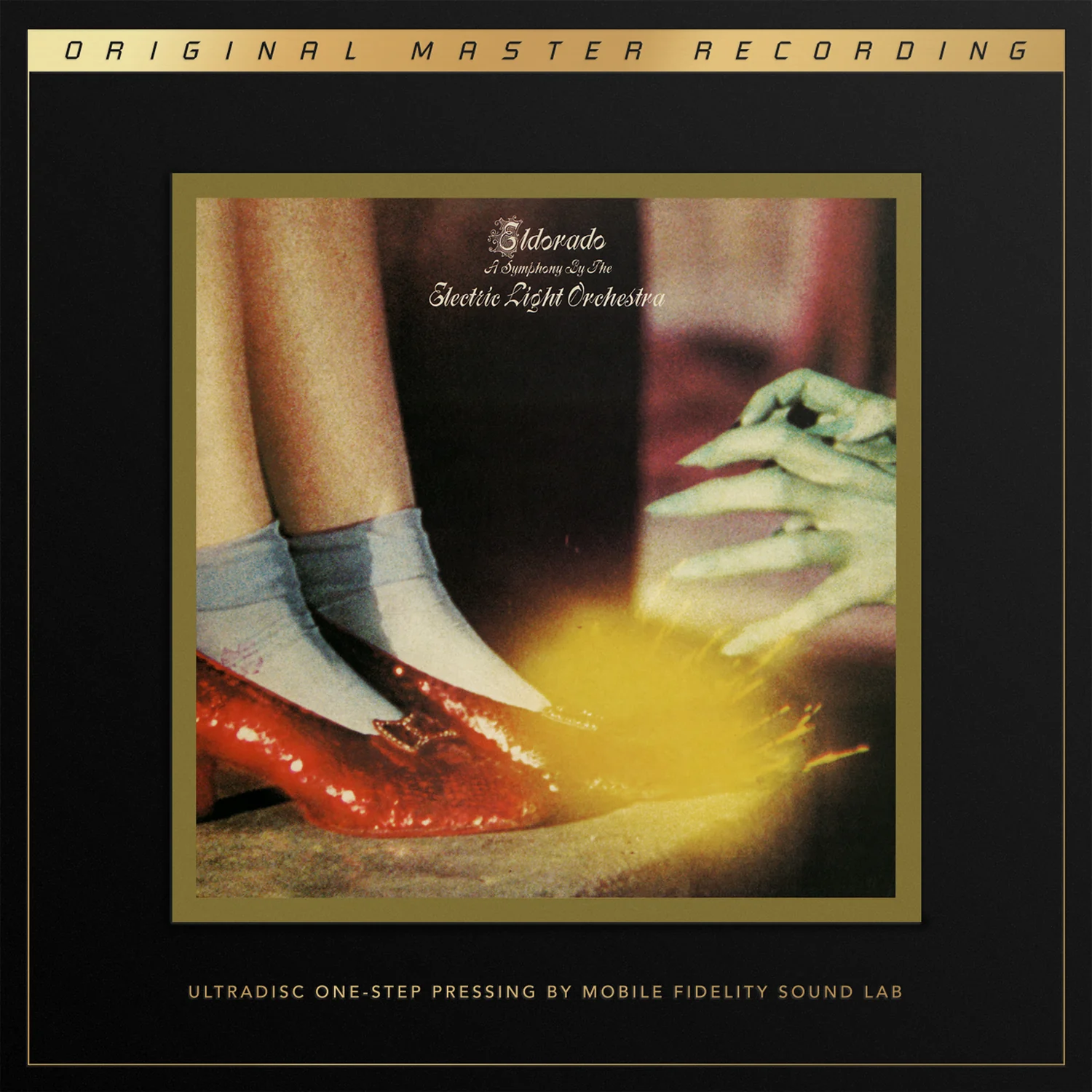
Electric Light
Orchestra leader Jeff Lynne did more than figuratively reach for the
sky on Eldorado. Daring to be bold, and creating imaginative worlds
that invite the listener to escape the mundane, the visionary
composer-musician achieved a multidisciplinary fantasia and, in the
process, a prog-rock landmark. Nearly 50 years later, the concept
album's brilliance can be experienced like never before in cinematic,
IMAX-worthy fashion.
Eldorado Overture
Can't Get It Out of
My Head
Boy Blue
Laredo Tornado
Poor Boy (The
Greenwood)
Mister Kingdom
Nobody's Child
Illusions in G Major
Eldorado
Eldorado Finale
Sourced from the
original analog master tapes, pressed on MoFi SuperVinyl vinyl at
RTI, housed in a keepsake box, and limited to 10,000 numbered copies,
Mobile Fidelity's UltraDisc One-Step 180g 45RPM 2LP set of Eldorado
allows the longtime audiophile staple to resonate with
reference-setting dynamics, tones, and colors. Conjuring the feeling
of journeying to different horizons, the record's songs teem with
layer upon layer of details, which can now be heard as the producers
intended. This very special release both pays tribute to the record's
merit and enhances the spectacular program for generations to come.
Presenting the album
with breathtaking clarity yet retaining the warmth, texture, and
emotion that differentiate live music from reproduced sounds, the
collectible reissue features beguiling levels of in-the-moment
presence, grand-scale soundstaging, and instrumental balance.
Bursting with a veritable cornucopia of stimuli, MoFi's Eldorado
package also benefits from superb separation and immersive
atmospherics that stem from the meticulous remastering process – as
well as an ultra-low noise floor, industry-leading groove definition,
and dead-quiet surfaces courtesy of the MoFi SuperVinyl properties.
The premium
packaging and gorgeous presentation of the UD1S Eldorado pressing
befit its extremely select status. Housed in a deluxe box, it
features special foil-stamped jackets and faithful-to-the-original
graphics that illuminate the splendor of the recording. No expense
has been spared. Aurally and visually, the reissue exists as a
curatorial artifact meant to be preserved, touched, and examined. It
is made for discerning listeners that prize sound quality and
production, and who desire to fully immerse themselves in everything
involved with the album.
An artistic
breakthrough that established Electric Light Orchestra as a
pioneering band (and confirmed Lynne as the leading practicing
Beatles disciple), the 1974 effort remains notable for its
involvement of a full orchestra and choral section, the range of
which are captured with exquisite results on this LP. Eldorado
distinguished itself from the band's first two works not only via
Lynne's sharpened songwriting but due to the hiring of an orchestra
that augmented the group's three string players. Co-arranged by Lynne
and conductor Louis Clark, the symphonic movements bolster the
contagious fare without ever drowning it. The accents also act as
transports into the varied narrative universes.
Finished as a story
before Lynne put notes down on paper, Eldorado ironically owes its
inspiration to Lynne's father. In response to his dad's criticisms
about the band, Lynne conceived a melodic tour de force that, like
The Wizard of Oz, which informs the cover art, emphasizes the power
of everyday dreams and everyman heroism. It's no coincidence that the
sonic journey begins with an overture punctuated by the words of a
cynic who condemns "the dreamer, the unwoken fool."
Beautiful yet fun,
ambitious yet consistent, Eldorado proceeds to celebrate such
romantics and escapists. A Technicolor escapade marked by lush
melodies, fluid crescendos, and an intoxicating blend of energetic
rock and sweeping orchestral elements, the album weds rich imagery
and sweeping sounds in manners that make the two inseparable. In
Lynne and company's hands, reality and fantasy collide, and dissolve
any dividing lines. The proof is not just in the epic production, but
in the timeless (and catchy) nature of songs such as the balladic
"Boy Blue," power-pop packed "Illusions in G Major,"
and, of course, the aptly titled hit, "Can't Get It Out of My
Head."
Decades later,
Eldorado doubles as an invitation to break away from monotony whether
you're listening to your Mobile Fidelity reissue on a large system or
an excellent pair of headphones.
MoFi SuperVinyl
Developed by NEOTECH
and RTI, MoFi SuperVinyl is the most exacting-to-specification vinyl
compound ever devised. Analog lovers have never seen (or heard)
anything like it. Extraordinarily expensive and extremely painstaking
to produce, the special proprietary compound addresses two specific
areas of improvement: noise floor reduction and enhanced groove
definition. The vinyl composition features a new carbonless dye (hold
the disc up to the light and see) and produces the world's quietest
surfaces. This high-definition formula also allows for the creation
of cleaner grooves that are indistinguishable from the original
lacquer. MoFi SuperVinyl provides the closest approximation of what
the label's engineers hear in the mastering lab.
More About Mobile
Fidelity UltraDisc One-Step and Why It Is Superior
Mobile Fidelity
Sound Lab's UltraDisc One-Step (UD1S) technique bypasses generational
losses inherent to the traditional three-step plating process by
removing two steps: the production of father and mother plates, which
are created to yield numerous stampers from each lacquer that is cut.
For UD1S plating, stampers (also called "converts") are
made directly from the lacquers. Since each lacquer yields only one
stamper, multiple lacquers need to be cut. Mobile Fidelity's UD1S
process produces a final LP with the lowest-possible noise floor. The
removal of two steps of the plating process also reveals musical
details and dynamics that would otherwise be lost due to the standard
multi-step process. With UD1S, every aspect of vinyl production is
optimized to produce the best-sounding vinyl album available today.
180g 45RPM 2LP Box SetMASTERED FROM THE ORIGINAL MASTER TAPES WITH MOBILE FIDELITY'S ONE-STEP PROCESS: PRESSED ON MOFI SUPERVINYL, LIMITED TO 10,000 COPIES (LIMIT ONE PER CUSTOMER)
Janis Joplin wouldn't be denied on Pearl. The powerhouse vocalist had kicked her addictions, teamed with a stupendous band, and partnered with a producer who knew how to best showcase her voice on record. She came to the sessions with an armload of astonishing songs, and a burst of creative energy that mirrored her rejuvenated emotional state and undeniable spirit. You can hear it on every note of the 1971 record. Ranked #135 on Rolling Stone's 500 Greatest Albums of All Time list, Pearl sold more than four million copies and stands as the first female rock superstar's definitive studio work. Mobile Fidelity's UD1S 180g 45RPM 2LP box set presents the landmark effort like never before.
Move Over
Cry Baby
A Woman Left Lonely
Half Moon
Buried Alive In the Blues
My Baby
Me and Bobby McGee
Mercedes Benz
Trust Me
Get It While You Can
Commemorating Pearl's 50th anniversary in collaboration with SME/Legacy Recordings, mastered from the original master tapes, cut at 45RPM, pressed on MoFi SuperVinyl at RTI, and limited to 10,000 copies, the iconic audiophile label's UltraDisc One-Step reissue takes Joplin and Co.'s stupendous performance to newly transcendent levels. Boasting reference-setting fidelity that further magnifies the singer's passion and producer Paul A. Rothchild's clear production, this pressing benefits from jaw-dropping spaciousness, presence, fullness, detail, dynamics, and openness. The wider grooves allow more information to reach your ears, and MoFi SuperVinyl means the noise floor is as absolutely low as possible.
Visually, the lavish packaging and gorgeous presentation of the UD1S Pearl befit its select status. Housed in a deluxe box, it features special foil-stamped jackets and faithful-to-the-original graphics that illuminate the splendor of the recording. No expense has been spared. Aurally and visually, this UD1S collectible exists as a curatorial artifact meant to be preserved, touched, and examined. It is made for discerning listeners that prize sound quality and production, and who desire to fully immerse themselves in the art – and everything involved with the album, from the images to the finishes.
Indeed, Joplin's husky, strong, and penetrating singing has never sounded more vibrant or made deeper connections. Warm, organic, and free of any artificial ceilings, this version lets you step into Sunset Sound Recorders with the performers, such is the degree of realism and authenticity. And few, if any words, describe Joplin better than "authentic." Her spirit comes to life on this reissue in sublime fashion. Like its headliner, this pressing leaves it all on the floor.
While Joplin's electrifying vocal prowess is universally lauded – she's deservingly recognized as the greatest white female blues singer the world has ever seen – her mix of compassion, confidence, and charm play as large a role in attracting listeners and keeping them ensnared more than four decades after her tragic death. And on Pearl, she burrows into deeper stylistic veins, teasing out sides of her persona and craft she'd never previously displayed. Her signature desperation, sadness, and vulnerability remain – the harrowing, lonely wail that begins her soul-ravishing take on Jerry Ragovoy's "Cry Baby," underlined with a Wall of Sound-like piano accompaniment, could only come from a person severely scarred by loss and disappointment – yet Joplin also reveals a sense of humor and beatnik innocence that helped propel the album to the top of the charts for nine straight weeks.
Playfully introduced as "a song of great social and political import," the a capella "Mercedes Benz" reflects Joplin's throaty timbre as well as her enhanced, sunnier mood. Similarly, her definitive read of Kris Kristofferson's "Me and Bobby McGee" signals a laidback demeanor and a move into country strains, with the delivery as natural, carefree, and loving as any in the rock canon. As she does throughout the record, Joplin invests her all in the narrative so that there's no line between the performer and the song. She makes everything on Pearl feel autobiographical, and by extension, gut-wrenchingly honest and devastatingly intimate. Joplin achieved these feats often during her brief career, yet there are differences on Pearl, chiefly among them her balance of impeccable timing and raw emotion. Heart-aching anthems such as "A Woman Left Lonely" offer both grit and control, subtlety and attack, resulting in cathartic releases distinguished with originality, personality, and instinctual passion.
Pearl remains Joplin's finest hour, with credit also owed to the Full Tilt Boogie Band – the only group she ever considered to be her own – as well as the Doors alum that sat behind the boards. Joplin and Rothchild both admitted to sharing a common bond and understanding, with the latter inheriting the role of teacher and Joplin, a willing student ready to discover how she could use her voice in new, more expressive ways. The fruits of the pair's labors fill Pearl, be it the guardedly optimistic "Get It While You Can" or assertive, fleet-footed "Move Over."
Experienced in the new light brought to fore by this definitive Mobile Fidelity UD1S box set, Joplin's swan song is no longer about a masterpiece that its creator never lived to see finished. Rather, it's about a once-in-a-lifetime vocalist realizing mammoth potential and wringing passion out of every note. It's not a tragedy, but a triumph. Get it while you can.
More About Mobile Fidelity UltraDisc One-Step and Why It Is Superior
Instead of utilizing the industry-standard three-step lacquer process, Mobile Fidelity Sound Lab's new UltraDisc One-Step (UD1S) uses only one step, bypassing two processes of generational loss. While three-step processing is designed for optimum yield and efficiency, UD1S is created for the ultimate in sound quality. Just as Mobile Fidelity pioneered the UHQR (Ultra High-Quality Record) with JVC in the 1980s, UD1S again represents another state-of-the-art advance in the record-manufacturing process. MFSL engineers begin with the original master tapes and meticulously cut a set of lacquers. These lacquers are used to create a very fragile, pristine UD1S stamper called a "convert." Delicate "converts" are then formed into the actual record stampers, producing a final product that literally and figuratively brings you closer to the music. By skipping the additional steps of pulling another positive and an additional negative, as done in the three-step process used in standard pressings, UD1S produces a final LP with the lowest noise floor possible today. The removal of the additional two steps of generational loss in the plating process reveals tremendous amounts of extra musical detail and dynamics, which are otherwise lost due to the standard copying process. The exclusive nature of these very limited pressings guarantees that every UD1S pressing serves as an immaculate replica of the lacquer sourced directly from the original master tape. Every conceivable aspect of vinyl production is optimized to produce the most perfect record album available today.
MoFi SuperVinyl
Developed by NEOTECH and RTI, MoFi SuperVinyl is the most exacting-to-specification vinyl compound ever devised. Analog lovers have never seen (or heard) anything like it. Extraordinarily expensive and extremely painstaking to produce, the special proprietary compound addresses two specific areas of improvement: noise floor reduction and enhanced groove definition. The vinyl composition features a new carbonless dye (hold the disc up to the light and see) and produces the world's quietest surfaces. This high-definition formula also allows for the creation of cleaner grooves that are indistinguishable from the original lacquer. MoFi SuperVinyl provides the closest approximation of what the label's engineers hear in the mastering lab.
MASTERED FROM THE ORIGINAL MASTER TAPES: LIMITED TO 8,000 NUMBERED COPIES180g 45RPM 2LP Box SetExorcising personal demons and reflecting on midlife circumstance, Paul Simon frames Still Crazy After All These Years as a post-divorce statement yet retains cutting humor and lighthearted cynicism that make every song universally appealing. A succession of brooding vocals, jazz-laden arrangements, contagious hooks, and an appearance by the famed Muscle Shoals rhythm section further conspire to make the record a lasting template for mature pop music that offers meaningful contemplation of relationships, transitions, disillusionment, and responsibility. A chart-topping statement that coincided with Simon's ascent as a superstar solo artist, it now sounds more immediate, cunning, and refined than ever courtesy of painstaking restoration.
Still Crazy After All These Years
My Little Town
I Do It for Your Love
50 Ways to Leave Your Lover
Night Game
Gone at Last
Some Folks' Lives Roll Easy
Have a Good Time
You're Kind
Silent Eyes
Limited to 8,000 numbered copies, pressed on MoFi SuperVinyl at RTI, and mastered from the original master tapes, Mobile Fidelity's ultra-hi-fi UltraDisc One-Step 180g 45RPM 2LP collector's edition enhances the music for generations to come. Surpassing the sonics of any prior version, it provides a clear, transparent, ultra-dynamic view of a record that won Grammy Awards for Album of the Year and Best Male Pop Vocal Performance. The expanse and depth of the soundstage, fullness of detail, reach of the omnipresent electric piano, and natural bloom and decay of individual notes all reach demonstration-grade levels.
Visually, the lavish packaging and gorgeous presentation of the UD1S Still Crazy After All These Years pressing befit its select status. Housed in a deluxe box, it features special foil-stamped jackets and faithful-to-the-original graphics that illuminate the splendor of the recording. No expense has been spared. Aurally and visually, this UD1S reissue exists as a curatorial artifact meant to be preserved, touched, and examined. It is made for discerning listeners that prize sound quality and production, and who desire to fully immerse themselves in the art – and everything involved with the album, from the images to the finishes.
The newfound immediacy, presence, texture, and dark-black backgrounds provided by Mobile Fidelity's UD1S set showcase the scope and craft of Simon's alluring melodies – as well as the intentional conflict between the tense lyrical content and the deceivingly pleasant aura. Still Crazy After All These Years resonates with a decided nasty streak and delves into adult romance with rapier wit. Indeed, in its original review of the album, Rolling Stone pertinently observes, "There is something ominous about the disparity between Simon and Phil Ramone's typically elaborate, creamy production and the downbeat theme of the album."
Nowhere is the distinction more pronounced than on the seductive, irony-rich smash "50 Ways to Leave Your Lover." Interviewed decades ago about its creation and appeal, Simon explained what makes the track structurally distinct. "I was studying harmony with [bassist Chuck Israels]. Instead of using a minor chord, I use a major chord and go up a step. It is hard to get an interesting key change. I also like to write a bridge and just jump a whole tone up." Needless to say, the approach worked. The song remains Simon's most successful solo hit, and joins three other tunes from the record to have climbed into the Top 40.
The other charting numbers – the loose-limbed title track (complete with a Michael Brecker saxophone solo), "Gone at Last" (a duet with Phoebe Snow), and "My Little Town" (which reunited Simon with his former partner Art Garfunkel for the first time in nearly five years) – prove equally sharp. In certain ways, Still Crazy After All These Years plays as the musical complement to Woody Allen's signature film Annie Hall, which, coincidentally, Simon would appear as a sleazy record producer. Relatedly, "Have a Good Time" witnesses Simon laughing his way through thinly disguised depression while the kiss-off "You're Kind" distills a splintered romance down to the preference of keeping a window open or closed.
"And you're good, you're so good/You introduced me to your neighborhood" Simon sings, slicing through pain with stinging zingers and a coy grin that announce the turning over of a new leaf, which culminated with his performing on "Saturday Night Live" in a turkey costume. But that's a story for another day.
More About Mobile Fidelity UltraDisc One-Step and Why It Is Superior
Instead of utilizing the industry-standard three-step lacquer process, Mobile Fidelity Sound Lab's new UltraDisc One-Step (UD1S) uses only one step, bypassing two processes of generational loss. While three-step processing is designed for optimum yield and efficiency, UD1S is created for the ultimate in sound quality. Just as Mobile Fidelity pioneered the UHQR (Ultra High-Quality Record) with JVC in the 1980s, UD1S again represents another state-of-the-art advance in the record-manufacturing process. MFSL engineers begin with the original master tapes and meticulously cut a set of lacquers. These lacquers are used to create a very fragile, pristine UD1S stamper called a "convert." Delicate "converts" are then formed into the actual record stampers, producing a final product that literally and figuratively brings you closer to the music. By skipping the additional steps of pulling another positive and an additional negative, as done in the three-step process used in standard pressings, UD1S produces a final LP with the lowest noise floor possible today. The removal of the additional two steps of generational loss in the plating process reveals tremendous amounts of extra musical detail and dynamics, which are otherwise lost due to the standard copying process. The exclusive nature of these very limited pressings guarantees that every UD1S pressing serves as an immaculate replica of the lacquer sourced directly from the original master tape. Every conceivable aspect of vinyl production is optimized to produce the most perfect record album available today.
MoFi SuperVinyl
Developed by NEOTECH and RTI, MoFi SuperVinyl is the most exacting-to-specification vinyl compound ever devised. Analog lovers have never seen (or heard) anything like it. Extraordinarily expensive and extremely painstaking to produce, the special proprietary compound addresses two specific areas of improvement: noise floor reduction and enhanced groove definition. The vinyl composition features a new carbonless dye (hold the disc up to the light and see) and produces the world's quietest surfaces. This high-definition formula also allows for the creation of cleaner grooves that are indistinguishable from the original lacquer. MoFi SuperVinyl provides the closest approximation of what the label's engineers hear in the mastering lab.
180g 45RPM
SuperVinyl 2LP Box Set
SOURCED FROM THE
ORIGINAL MASTER TAPES AND LIMITED TO 10,000 NUMBERED COPIES
1/4" / 15 IPS /
Dolby A analog master to DSD 256 to analog console to lathe
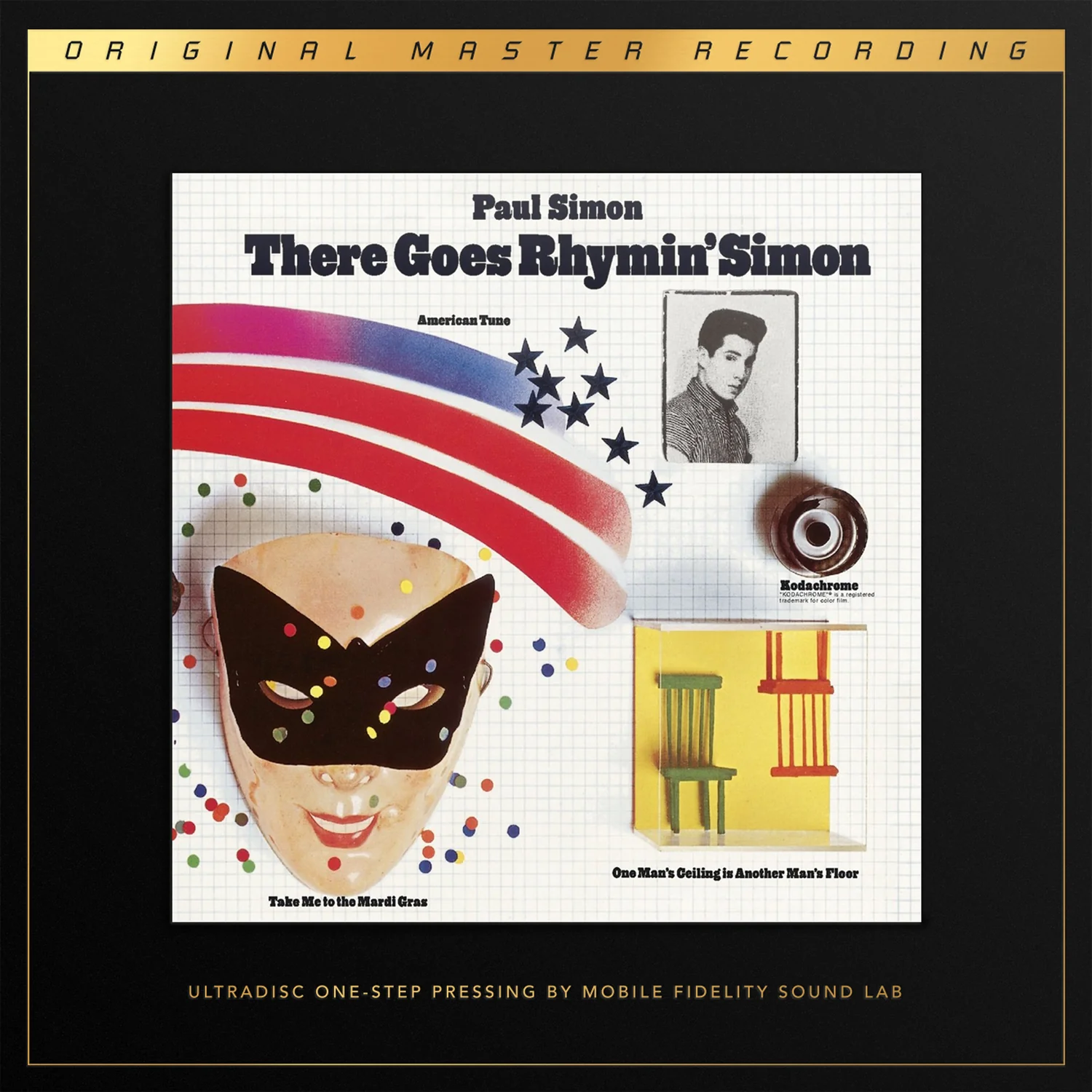
Demonstrating a
deep-seated flair for soul and R&B, Paul Simon recruited gospel
backup singers and traveled to the Muscle Shoals Sound Studios to
further refine the vibrant sounds he desired for There Goes Rhymin'
Simon. Clearly, his instincts proved correct. Many rightly consider
the iconic singer-songwriter's third album a masterpiece – one
that, per critic Robert Christgau, "suggests a new grace and
flexibility for the mass-pop mode, and invests small subjects and
emotions with an almost luminous wit and awareness."
Kodachrome
Tenderness
Take Me to the Mardi
Gras
Something So Right
One Man's Ceiling Is
Another Man's Floor
American Tune
Was a Sunny Day
Learn How to Fall
St. Judy's Comet
Loves Me Like a Rock
Limited to 10,000
numbered copies, pressed on MoFi SuperVinyl at RTI, and sourced from
the original master tapes, Mobile Fidelity's UltraDisc One-Step 180g
45RPM 2LP collector's edition makes for an extraordinary listening
experience. It strips away any remaining barriers to provide a clear,
super-dynamic view of a record nominated for two Grammy Awards and
that climbed to the No. 2 position on the Billboard charts. The
expanse and depth of the soundstage, fullness of detail, varied
textures of the percussion, and natural rise and decay of individual
notes reach demonstration-grade levels.
Visually, the
gorgeous presentation of the UD1S There Goes Rhymin' Simon pressing
befit its select status. Housed in a deluxe box, it features special
foil-stamped jackets and faithful-to-the-original graphics that
illuminate the splendor of the recording. It is made for discerning
listeners that prize sound quality and production, and who desire to
fully immerse themselves in everything involved with the album.
The newly revealed
transparency, presence, balance, immediacy, and dark-black
backgrounds provided by Mobile Fidelity's UD1S set showcase the scope
and craft of Simon's alluring melodies – not to mention the vocal
performances that, arguably, remain the album's standout element.
Simon's singing hits peaks on There Goes Rhymin' Simon that equal or
best those on any of his other works, Simon and Garfunkel included.
Assured, natural, and supple, his baritone resonates with a realism
and extension that immerse you in the song. At certain times, he lets
loose; during others, he becomes a gentle balladeer on par with a
prized jazz chanteur. Such versatility alone remains staggering, but
he also receives support on two tracks by the legendary Dixie
Hummingbirds. The pairing is nothing short of magical.
Ditto Allen
Toussaint's horn arrangements on "Tenderness" and Quincy
Jones' string charts for "Something So Right." The title of
the latter tune could serve as the catch-all statement for There Goes
Rhymin' Simon – nothing seems out of place, overlooked, overcooked,
or underdone. The same goes for the playing of the cadre of session
pros heard on the record. A partial lineup: Southern virtuoso Pete
Carr (Joan Baez, Bob Seger, Rod Stewart), Muscle Shoals Rhythm
Section member Jimmy Johnson, and R&B master Cornell Dupree on
guitar; Muscle Shoals Sound Studio founder David Hood, Blue Note
veteran Bob Cranshaw, and Astral Weeks contributor Vernie Robbins on
bass; Fourplay founder Bob James on Fender Rhodes and keyboards;
soul-jazz expert Grady Tate and Aretha Franklin collaborator Rich
Marotta on drums. Mercy.
The proof of the
consummate chemistry, of course, resides in the final results, which
run the gamut from Jamaican-leaning rhythms and orchestral flourishes
to steady blues currents and New Orleans-soaked brass accents.
Simon's instinct for strong narrative conveyed with heartfelt emotion
completes a trifecta of instrumentation, arrangement, and delivery.
Taking a pulse on episodes such Watergate and the Vietnam War, the
singer meditates on experiences universal to everyone in America –
never more saliently than on "American Tune," an anthem
musically based on a hymnal and whose lyrics continue to hold true
today. Similarly, Simon spins gleeful absurdity, antisocial behavior,
and pensive reflection into truth on "Kodachrome," a
number-two smash that permanently established him as a solo star.
Hits and singles
aside, There Goes Rhymin' Simon stands as as a cohesive statement
woven together, to quote Rolling Stone critic Stephen Holden, as "a
rich and moving song cycle, one in which each cut reflects on every
other to create and ever-widening series of refractions."
Indeed, everything looks worse in black and white, and Mobile
Fidelity's UD1S set plays with the greens of summers and those nice
bright colors.
More About Mobile
Fidelity UltraDisc One-Step and Why It Is Superior
Instead of utilizing
the industry-standard three-step lacquer process, Mobile Fidelity
Sound Lab's new UltraDisc One-Step (UD1S) uses only one step,
bypassing two processes of generational loss. While three-step
processing is designed for optimum yield and efficiency, UD1S is
created for the ultimate in sound quality. Just as Mobile Fidelity
pioneered the UHQR (Ultra High-Quality Record) with JVC in the 1980s,
UD1S again represents another state-of-the-art advance in the
record-manufacturing process. MFSL engineers begin with the original
master recordings, painstakingly transfer them to DSD 256, and
meticulously cut a set of lacquers. These lacquers are used to create
a very fragile, pristine UD1S stamper called a "convert."
Delicate "converts" are then formed into the actual record
stampers, producing a final product that literally and figuratively
brings you closer to the music. By skipping the additional steps of
pulling another positive and an additional negative, as done in the
three-step process used in standard pressings, UD1S produces a final
LP with the lowest noise floor possible today. The removal of the
additional two steps of generational loss in the plating process
reveals tremendous amounts of extra musical detail and dynamics,
which are otherwise lost due to the standard copying process. Every
conceivable aspect of vinyl production is optimized to produce the
most perfect record album available today.
MoFi SuperVinyl
Developed by NEOTECH
and RTI, MoFi SuperVinyl is the most exacting-to-specification vinyl
compound ever devised. Analog lovers have never seen (or heard)
anything like it. Extraordinarily expensive and extremely painstaking
to produce, the special proprietary compound addresses two specific
areas of improvement: noise floor reduction and enhanced groove
definition. The vinyl composition features a new carbonless dye (hold
the disc up to the light and see) and produces the world's quietest
surfaces. This high-definition formula also allows for the creation
of cleaner grooves that are indistinguishable from the original
lacquer. MoFi SuperVinyl provides the closest approximation of what
the label's engineers hear in the mastering lab.
160,00 €*
Diese Website verwendet Cookies, um eine bestmögliche Erfahrung bieten zu können. Mehr Informationen ...